About the project / Eric Storm
Gardens of Earth
Vascular Los Angeles and the Biourban Future
An evolving research and design project asking how the places we inhabit could become more living, shaded, water-literate, human-centered, and resilient. It begins with Los Angeles and looks toward a wider future, shaped by the realities of each place.
The shared idea
A city designed to support life.
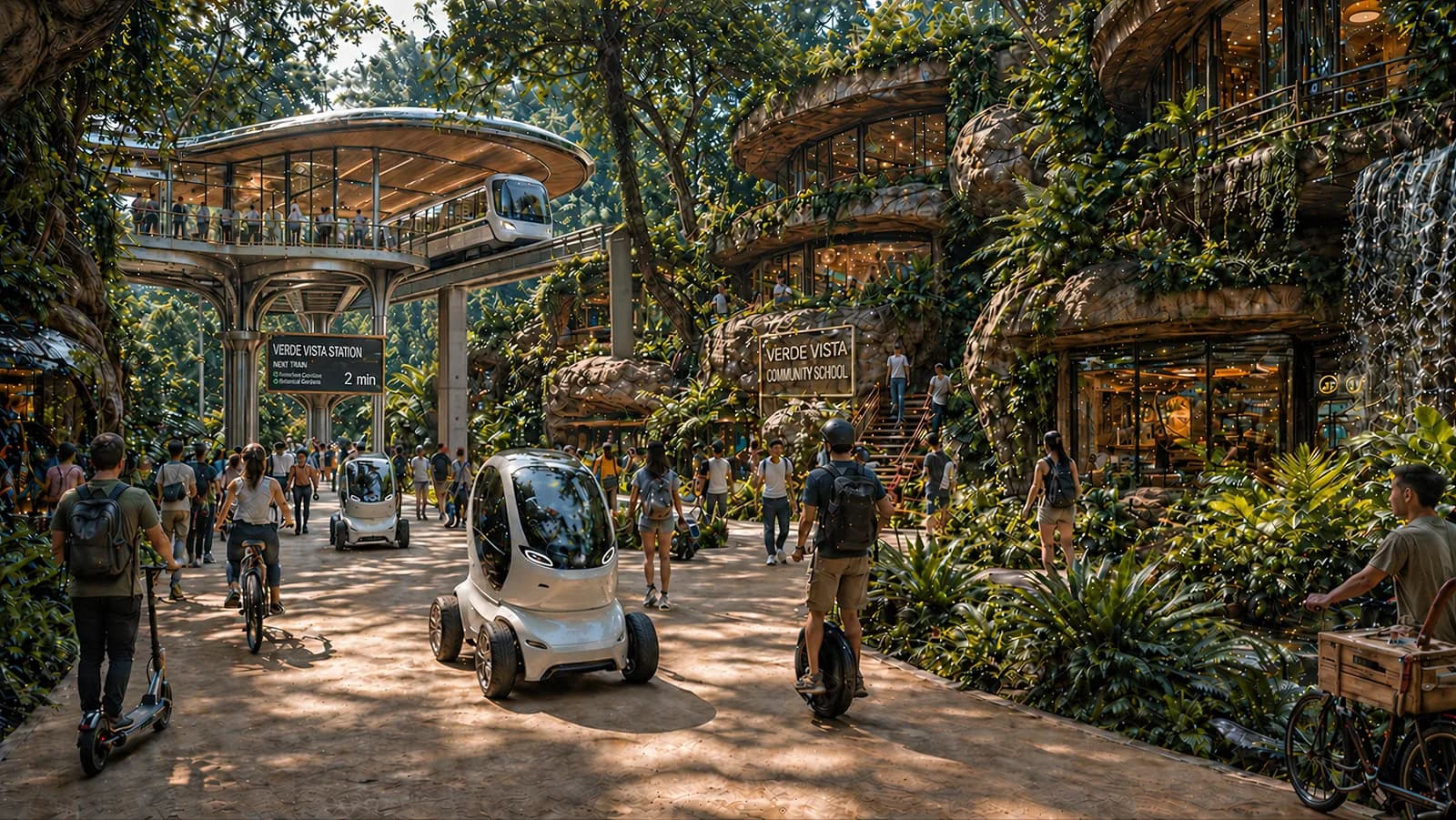
Gardens of Earth treats a city as a connected life-support system. Buildings, water, transport, energy, landscape, and civic life should not be designed as if they have nothing to do with one another. The vascular metaphor describes regional arteries feeding finer neighborhood connections: the places where people walk, meet, work, and receive the services they depend on.
This is not a call to abandon technology. It is a proposal to turn technical sophistication toward a kinder ground: less danger from fast-moving vehicles, more comfortable public space, healthier ecological relationships, and a daily life with room for beauty and belonging.
- Water & living ground
- Connect water reuse, treatment, storage, and appropriate recharge with the land that supports them. Remember contamination and preserve flood safety before opening new relationships between water, soil, and people.
- Terrain & construction
- Explore terrain-integrated places with an engineered structural backbone and adaptable surfaces. Reused materials, planted edges, fabrication, inspection, and repair belong in the same design conversation.
- Movement & access
- Give regional transit, walking, cycling, and local mobility distinct, connected roles. Investigate concepts such as the Metro Hopper without making everyday access depend on an unproven future vehicle.
- Canopy, habitat & energy
- Design shade, roots, water demand, habitat, food-growing spaces, and energy use together. A greener city needs a credible resource budget and continuing care, not simply a lush rendering.
- Culture & the right to remain
- Make room for craft, markets, gathering, and community authorship. Public investment should serve the people already there, with housing stability, accessibility, public ownership, and maintenance treated as infrastructure.
- Gaia & stewardship
- Develop ways to explore proposed environments and make evidence visible through Gaia Earth Simulator. The book's stewardship-accounting ideas, including GOE Coin, concern verified care rather than speculative financial promises.
The first research landscape
Vascular Los Angeles.
Los Angeles is the book's detailed starting point, not a claim of an already transformed biourban city. The proposal investigates how its river corridors, water networks, transit connections, inhabited terrain, and public spaces could become parts of a more coherent, car-light urban landscape.
The LA River is a powerful thread through that exploration. Greening a corridor must work with flood conveyance, water quality, access, habitat, and the communities beside it. Across the basin, dry-season water supply, groundwater, contaminated land, fire, earthquakes, and coastal change make the work much more demanding than the original image of a forested city.
The book therefore proposes a gradual path through research, university testbeds, bounded demonstrations, and carefully reviewed expansion. Its 2026-2076 roadmap is a planning horizon, not a construction promise. Housing protections, public participation, qualified engineering, and funded operation must advance with the physical work.
Explore the research and proposed pilots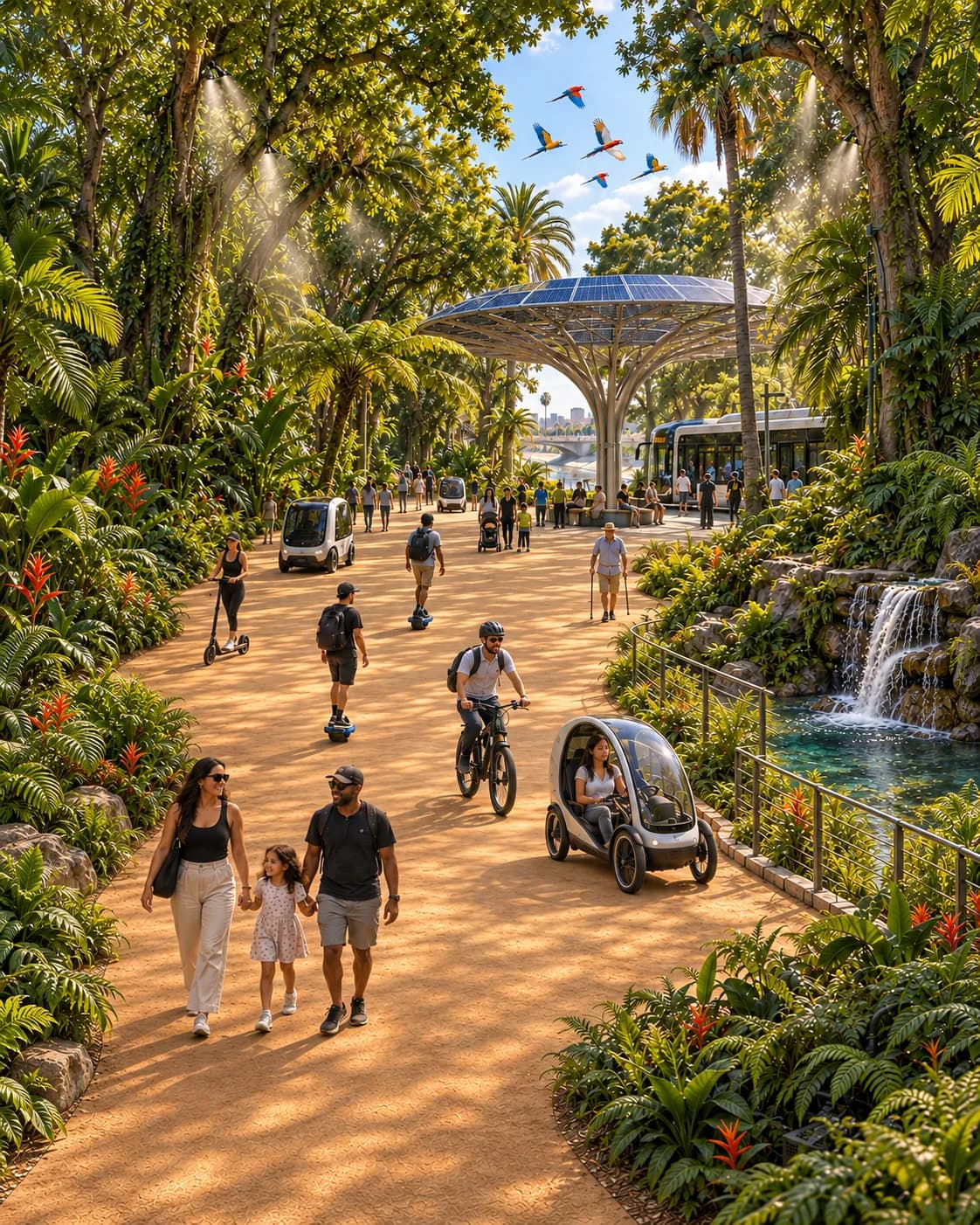
Investigate
Understand the place, establish baselines, and agree on responsibilities.
Test
Study materials, water, planting, access, and repair in bounded testbeds.
Demonstrate
Pursue limited pilots with permissions, funded care, and public review.
Connect
Expand or adapt only when evidence and community commitments support it.
A worldwide ambition
Shared principles. Different landscapes.
The longer-term ambition is gradual worldwide adoption through local adaptation. Share useful methods, tested components, and honest evidence; let each place develop its own expression. A living city should grow from its watershed, climate, geology, ecology, and existing settlement, not from a universal image of tropical greenery.
These are directions for future research and collaboration, not an announced international rollout. A successful experiment in Los Angeles would not, by itself, establish what is safe or appropriate elsewhere.
- Hot, water-limited places
- Begin with the water budget, heat exposure, soil, and drought conditions. Choose locally suitable planting and dependable shade; do not assume a tropical canopy can be sustained everywhere.
- Humid & high-rainfall places
- Give drainage, flood storage, ventilation, water quality, and habitat their appropriate roles. More greenery is not a substitute for understanding how water and heat move through a district.
- Temperate & cold-season places
- Account for seasonal sunlight, winter access, freeze conditions, and changing vegetation. The useful balance between shelter, shade, warmth, and public space will differ from Los Angeles.
- Coastal, steep & seismic places
- Let coastal change, slopes, geology, groundwater, and structural risks determine what is appropriate. Some places may support restoration; others may require containment, protection, or a different location.
Physical adaptation and cultural authorship belong together. Local communities, knowledge, institutions, materials, and traditions should shape the result. The right to remain and the responsibility to maintain it travel with the idea.
The future this project urges
Earth is the first worldship.
The preface's final metaphor brings the work back to Earth: a shared home whose water, energy, soil, ecology, and governance deserve deliberate, sustained care. The aim is not escape from the planet, but a better way to inhabit it.
Gardens of Earth is a research journey and civic design proposal, not a finished engineering plan or an adopted government program. It urges a future with safer movement, dependable shade, cleaner water, remembered contamination, beautiful public life, and communities able to stay and benefit from the places they help renew.
“Perhaps repairing Earth is how it becomes worthy of the stars.”
Eric Storm / Preface, Gardens of Earth