01The organizing idea
A city that works as a living system.
The book does not begin with a new architectural style. It begins with the relationships between the systems a city depends on.
Its vascular metaphor gives those relationships an anatomy: a structural skeleton; transport and water arteries; neighborhood-scale capillaries; treatment organs; a cooling canopy; and a nervous system for observation and coordination. The point is integration, not a claim that a city behaves exactly like a body.
Large regional networks would serve finer-grained places where people walk, meet, work, and receive services. Rail carries the regional journey. Small pathways and local distribution systems complete it. Water infrastructure supports a canopy; the canopy makes those everyday journeys more comfortable.
The design task is to manage boundaries: fresh and saline water, hot and cool spaces, surface and subsurface systems, clean and contaminated ground, public and private space, and floodable and protected land. Each boundary needs an operating rule, not just an attractive rendering.
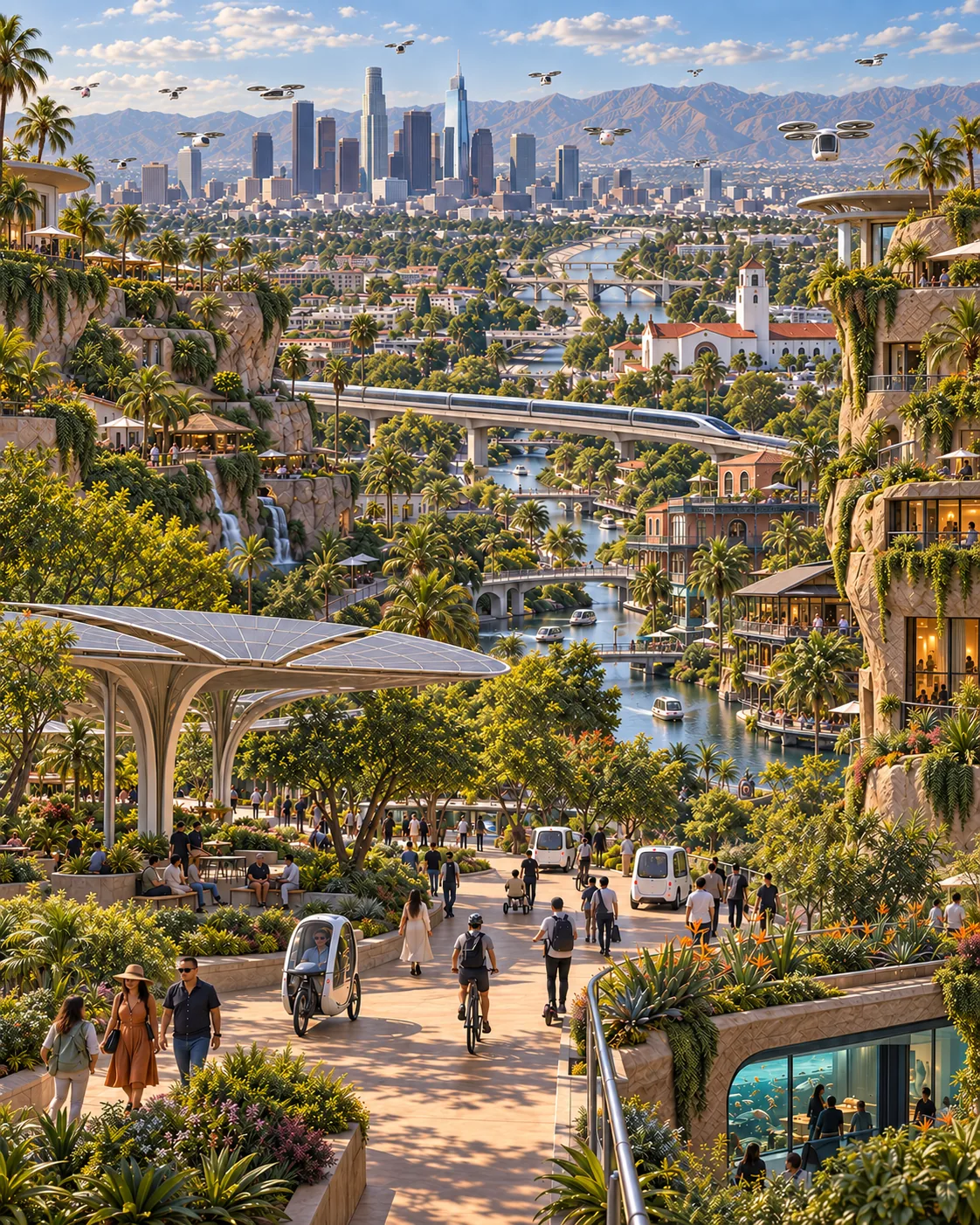
Book references Chapters 3-5: managed gradients, capillary urbanism, and Vascular Los Angeles.
02The hydrological foundation
Let water circulate. Know what lies beneath.
Vascular Los Angeles proposes a coordinated water system rather than a collection of isolated canals. Advanced purification, approved reuse, stormwater capture, groundwater replenishment, and coastal freshwater barriers would serve different roles within a reconciled water budget. The book uses Pure Water Los Angeles / Operation NEXT as a planning foundation, not as a supply already committed to this vision.
The aquifers form a second, largely invisible city. Managing them requires attention to hydraulic head, saline intrusion, pumping, shallow groundwater, and the possibility that added water can mobilize buried contamination. A greener surface does not erase an industrial history underground.
Different reaches therefore need different designs. Clean, suitable ground may allow recharge or carefully managed emergence. Contaminated reaches may require lined, underdrained treatment, sealed conveyance, or continued exclusion. A sealed civic water feature is not a restored wetland, and a bypass is not remediation.
The question before the landscape
Where can water safely enter the ground, where must it remain contained, and who is responsible when conditions change? Site investigation, water-quality permissions, flood compatibility, monitoring, and a funded response come before public contact or recharge.
Book references Chapters 6-15: recycled water, aquifer barriers, controlled emergence, and contamination containment.
03Artificial urban geology
Build the spine. Adapt the skin.
The artificial lithosphere is the book's proposal for useful, shaped ground: terraces, retaining structures, planted edges, service galleries, and public routes that accommodate water, roots, people, and maintenance together. Rocklike form matters when it performs a real task, not merely when it resembles geology.
The Spine/Skin Doctrine assigns life-safety duties to a conventional, engineered backbone. Gravity loads, seismic resistance, major water containment, emergency routes, and inspection access cannot depend on an unqualified experimental surface.
The adaptive skin is where carefully bounded experimentation belongs: replaceable facings, planter assemblies, filter housings, low-pressure channels, sensor cavities, and civic textures. Robotic fabrication may help make complex forms, but a printer does not remove the need for reinforcement, curing, inspection, or proof of performance.
Even a nonstructural panel carries weight and needs reliable attachments. Saturated soil, root growth, drainage, fire exposure, and seismic movement have to be tested at their interfaces. The hydroseismic idea of using contained water to influence structural response remains a research question, not demonstrated protection for an inhabited district.
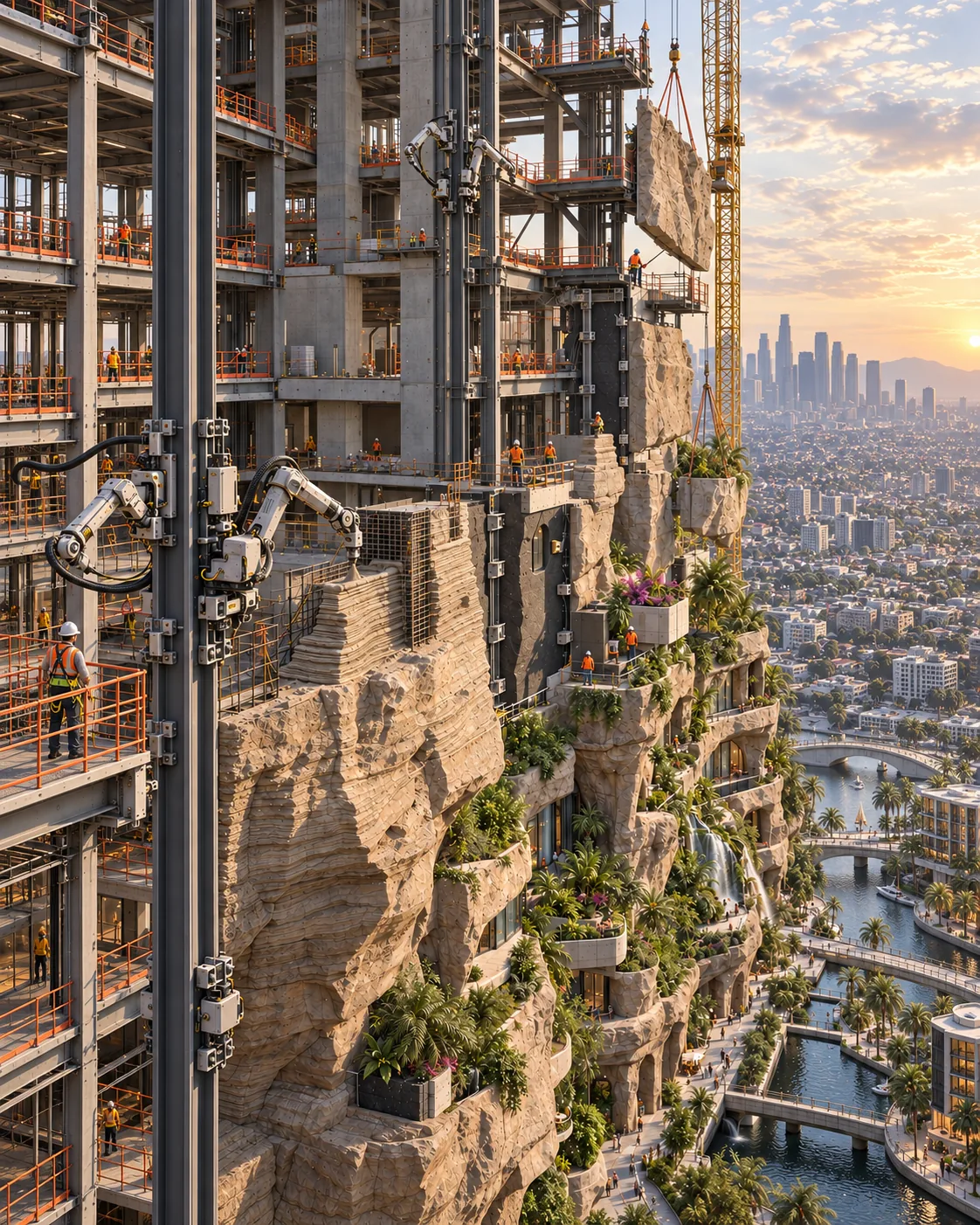
Book references Chapters 16-26: artificial geology, the Spine/Skin Doctrine, robotic construction, and the canal-edge pilot.
04Regional arteries, local capillaries
A mobility matrix for a human-scale city.
The transportation proposal gives different modes different jobs. High-capacity rail provides the regional spine. Walking, cycling, accessible local routes, and small passenger or service vehicles complete neighborhood trips. The aim is less land consumed by traffic and parking, with more space for useful public life.
Boats belong only in reaches where water quality, depth, flood operations, landings, demand, and maintenance make them feasible. The Metro Hopper explores a modular passenger cabin and different transport attachments. Aerial access and advanced guideways remain proposals with unresolved engineering, approval, cost, and operating questions.
The most important test is the whole journey: transfers, waiting, accessible lifts, freight, emergency response, and service during outages. Road space should change through evidence-led transitions with usable alternatives, not through a promise that a future vehicle will solve every trip.
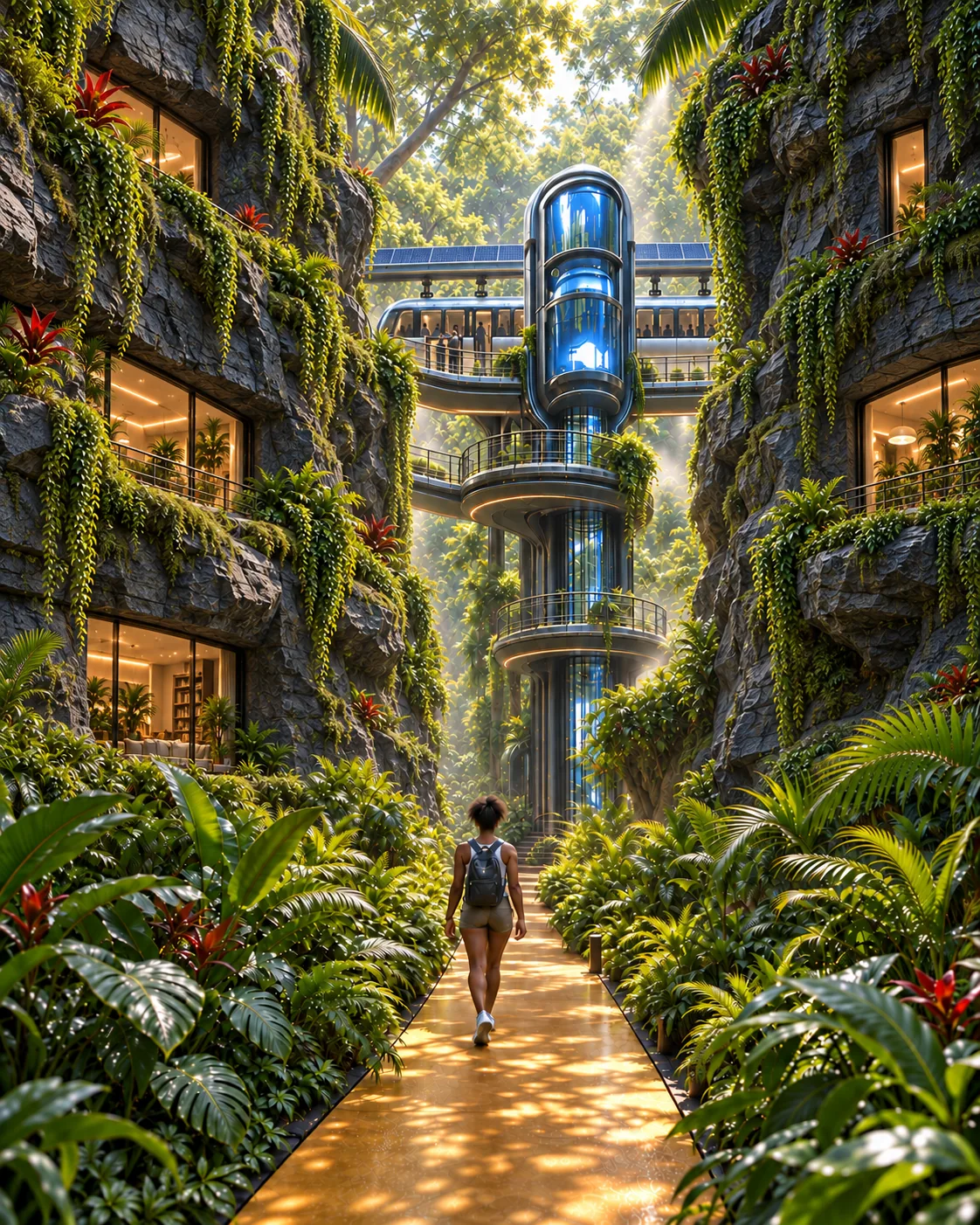
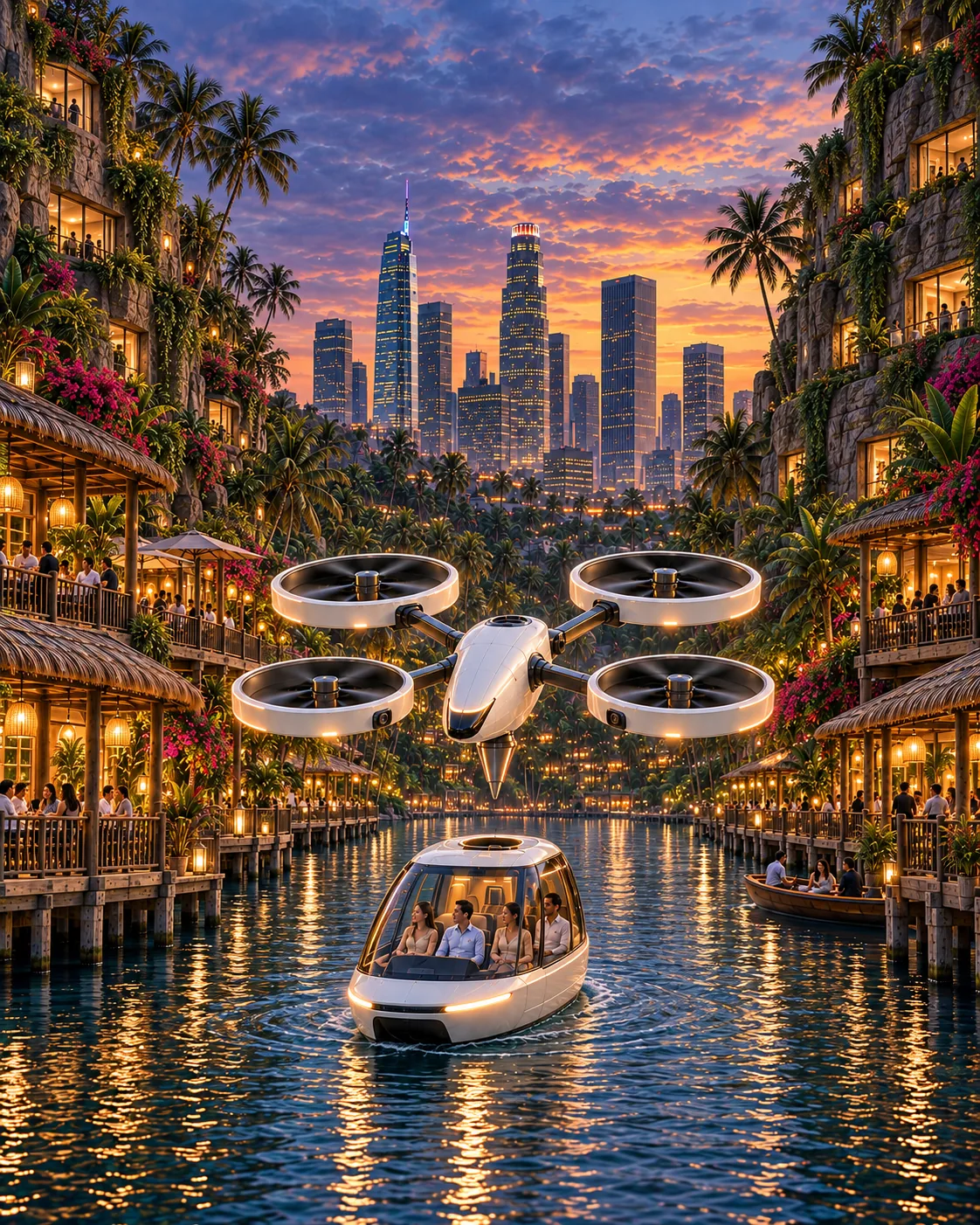
Book references Chapters 29-33: the transportation matrix, rail spine, moat-and-boat corridors, aerial access, and Metro Hopper.
05Heat, water, roots, and shade
A cooling corridor is an inhabited section.
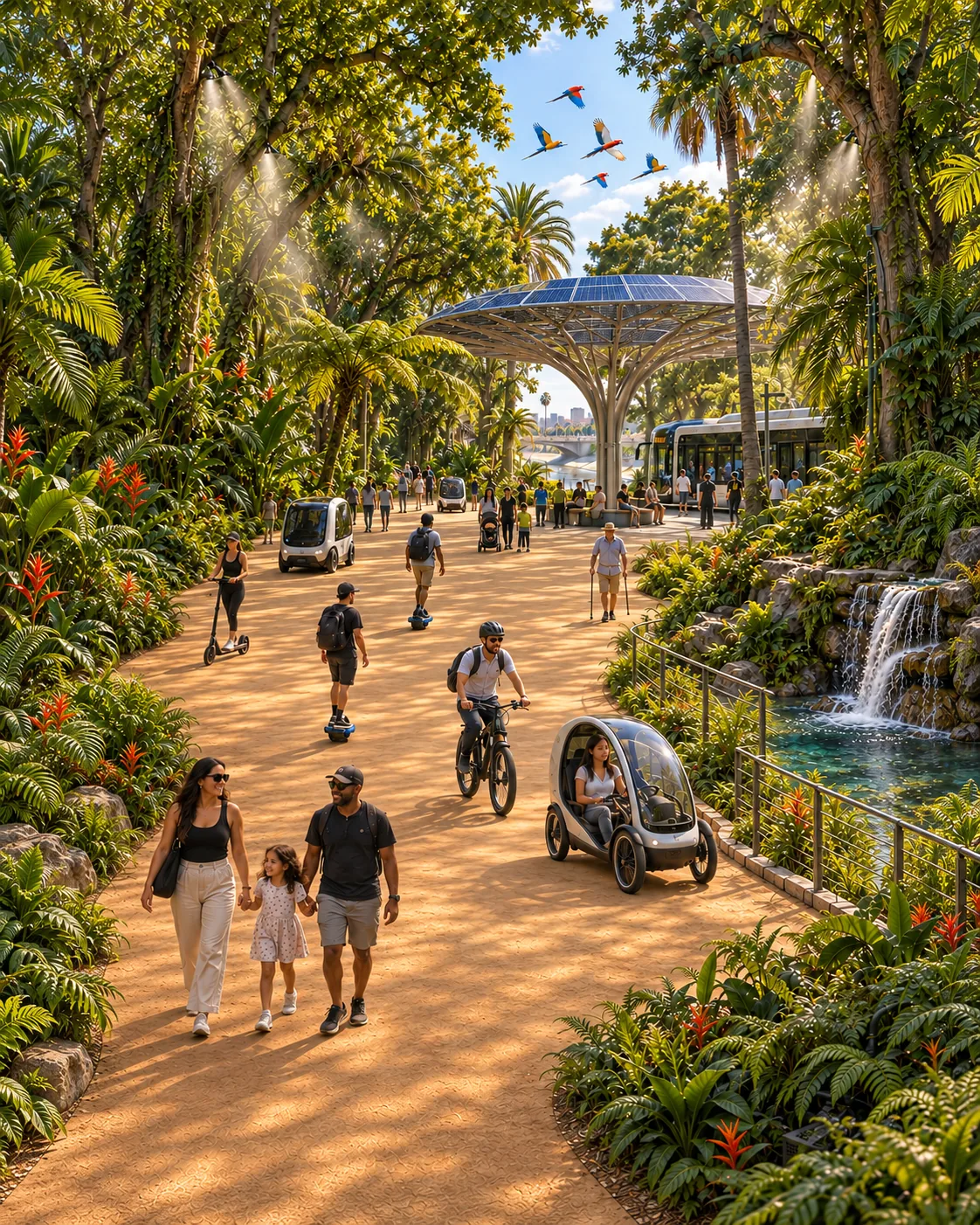
A waterway is not automatically a cool place. What a person experiences depends on shade, surrounding surface temperatures, air movement, humidity, the route, and the places where they have to wait. The book treats cooling as the design of a complete section, from soil and water to canopy and the moving body.
The managed forest needs adequate root space, a credible irrigation budget, drainage, species diversity, and continuing care. Species must fit the actual coastal or inland microclimate, recycled-water chemistry, wind, pests, and fire conditions. A lush appearance is not a planting specification.
Native river habitats and introduced plants in controlled urban refuges have different ecological roles. Temporary or structural shade must serve people while trees mature. Monitoring should distinguish a cooler pavement from lower air temperature or reduced radiant heat exposure.
The book also examines larger atmospheric questions, including the biotic pump hypothesis. Those investigations must not be turned into a promise of induced rainfall or regional climate control. Local thermal benefits and regional atmospheric effects require different evidence.
- Shade
- Coverage where people walk, wait, and rest.
- Exposure
- Radiant heat, humidity, airflow, and weather.
- Water
- Seasonal demand, quality, and reliable supply.
- Roots
- Soil volume, drainage, survival, and care.
Book references Chapters 34-37: the thermal city, managed urban forest, riparian cooling, and the biotic pump hypothesis.
06The civic surface
Beauty belongs to the people who make a place.
The book argues that survival infrastructure should also support an everyday life worth inhabiting: workshops, markets, gardens, shaded thresholds, gathering places, and streets with recognizable character. Craft gives the adaptive surface a role beyond camouflage. It can provide work, repair knowledge, local expression, and care.
The District Atlas is a collection of possible civic worlds, not a map of approved developments or identities assigned to neighborhoods. Cultural references require community authorship, paid participation, permission, attribution, and a way to revise work that proves inaccurate or unwelcome. Fantasy should be identified as fantasy rather than offered as an authentic history.
A replaceable civic skin makes that authorship ongoing. Residents can change the stories and patterns of a place without rebuilding its structural backbone. The public realm should remain genuinely public, including for people who are not customers, tourists, or residents of a privately managed development.
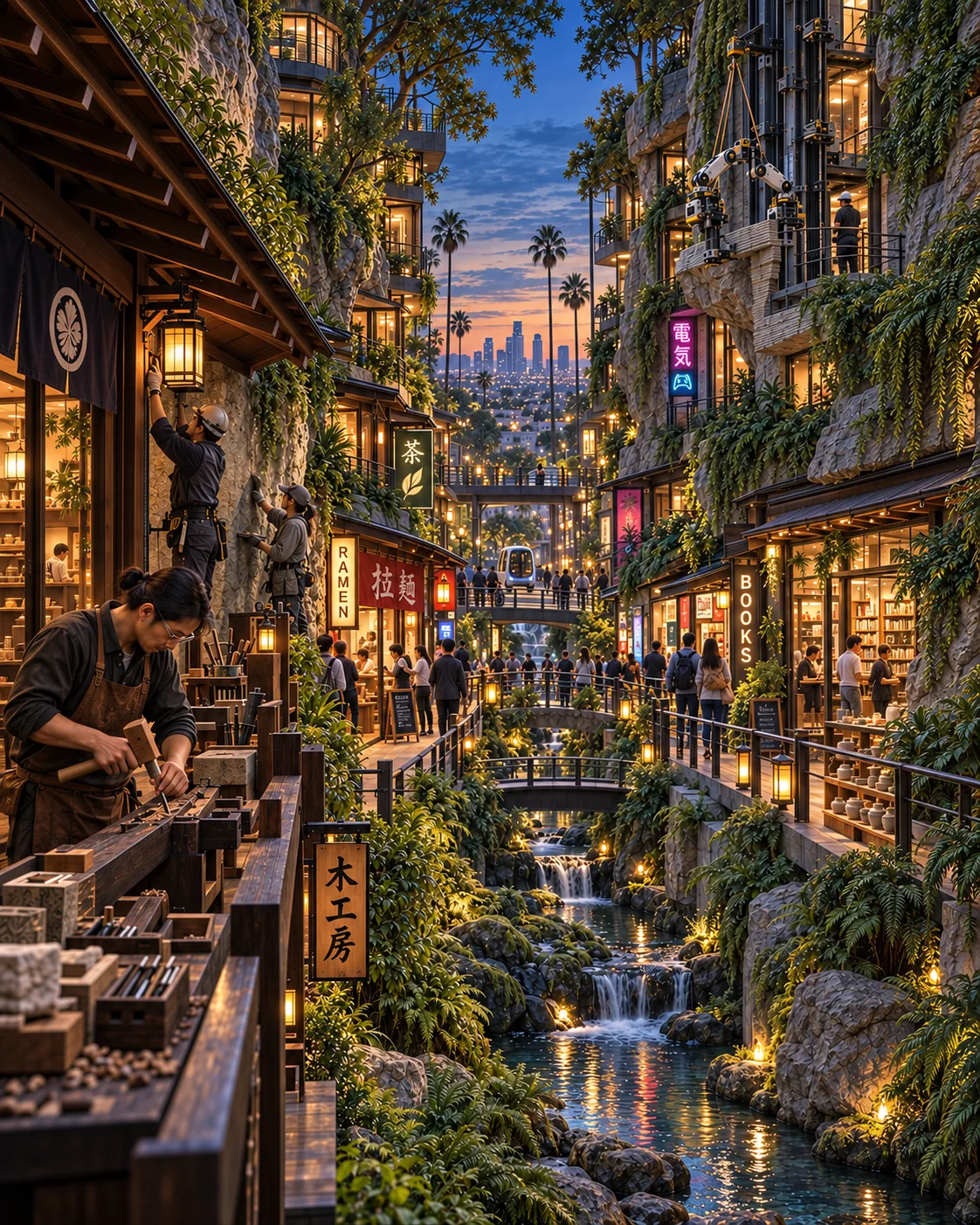
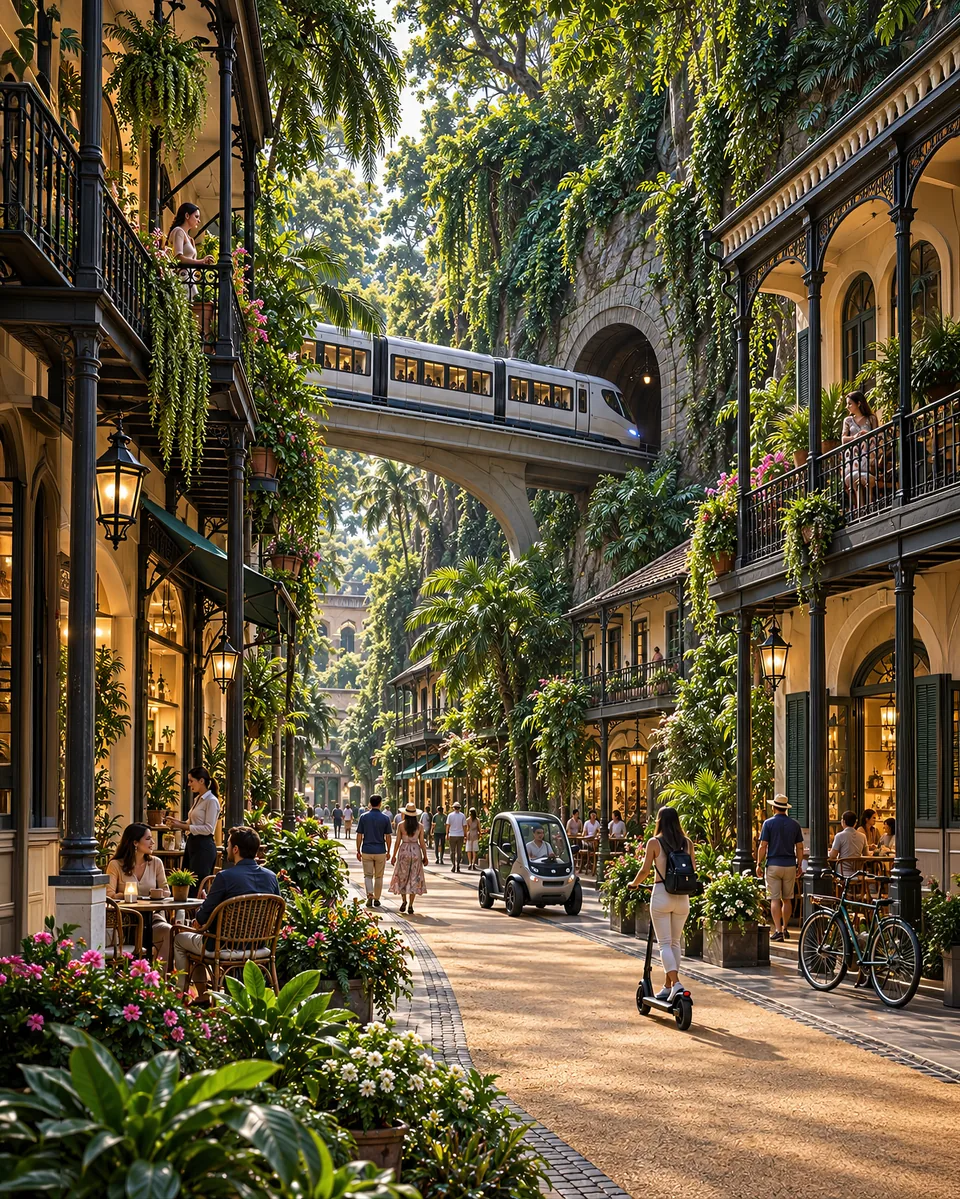
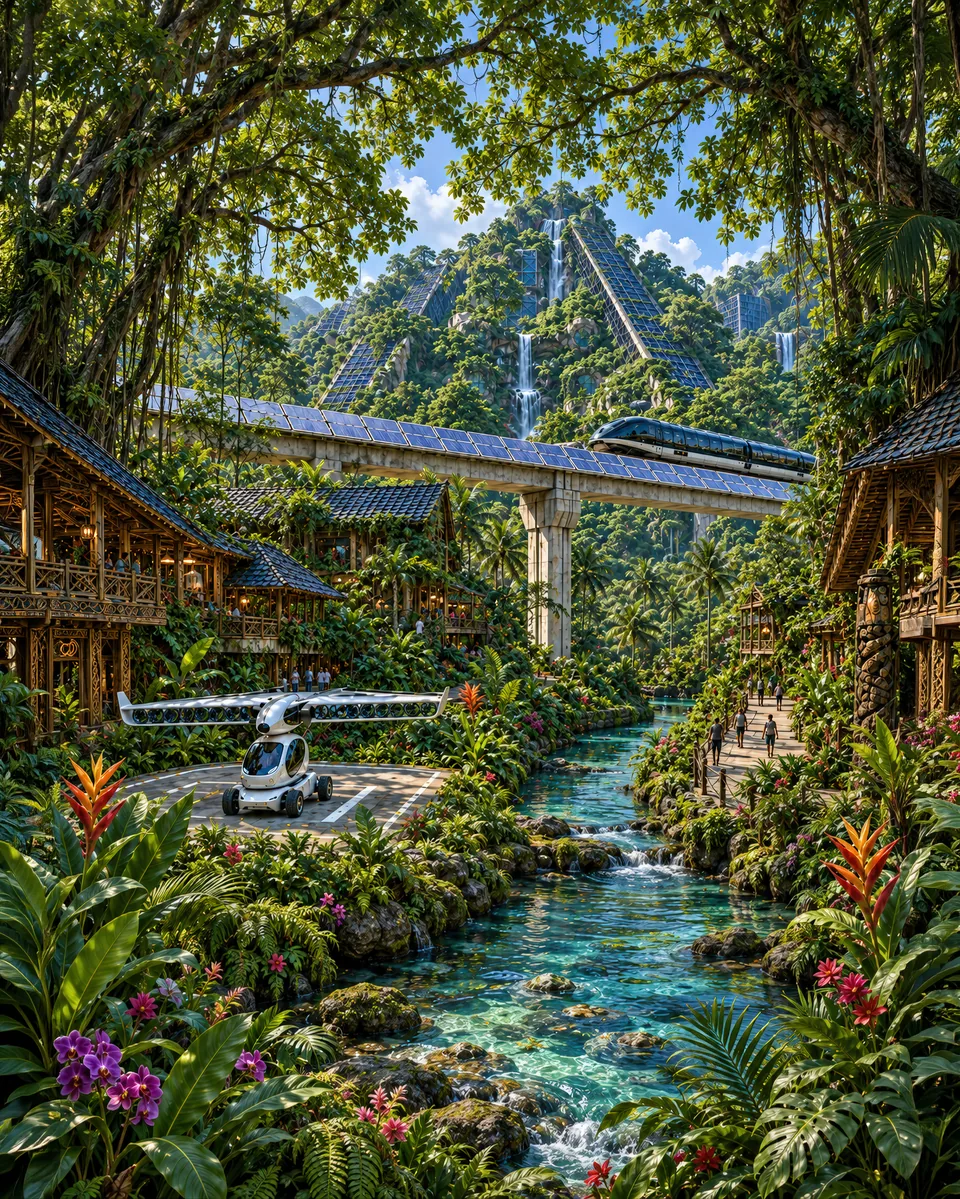
Book references Chapters 38-41: beauty, craft and public life, themed urbanism, and the District Atlas.
07The social lithosphere
A greener city must hold its people.
Improved shade, access, and public space can increase land value without improving the security of the people already there. The book treats the right to remain as part of the infrastructure, not a benefit to negotiate after redevelopment begins.
Proposed tools include public and community landholding, long-term affordability, tenant support, suitable replacement housing before necessary displacement, enforceable return arrangements, local business continuity, and paid participation. Their legal basis, financing, coverage, and enforcement would have to be established for each project. A principle alone is not a protection.
The proposed Vascular LA Authority and Public Revenue Covenant address the same question at an institutional scale: who controls the assets, who benefits from their value, and who pays to care for them decades later? Public safety, maintenance, renewal, and housing safeguards need dependable resources from the beginning. The book proposes these arrangements; it does not describe an existing authorized program.
Measure the social outcome too
Housing stability, business continuity, accessible travel, local work, complaints, and public access belong beside water and structural performance in the evaluation. A technically successful installation can still fail its neighbors.
Book references Chapters 42-49: capital, public authority, the social lithosphere, public care, and development rights.
08Observation, records, and accountability
Make the living system legible.
The digital thread connects a component's intended role to its material batches, fabrication record, tests, installed identity, inspections, repairs, and replacement. A convincing three-dimensional scene is not the same thing as a verified asset record. The record must preserve what was predicted before later measurements change the model.
The proposed Gaia Earth Simulator (GES) layer brings that evidence into operation. It would support an operator view for diagnosis, a public view of service and restrictions, and a community-review view connecting performance to budgets, complaints, and commitments. These should be different views of a reconciled record, not different versions of the truth.
Missing data should remain visible. Pending laboratory results should stay pending. Models need named owners, assumptions, versions, validation, and known limits. Protective equipment responses, operator decisions, and institutional authority must remain distinct. A dashboard cannot grant permission or guarantee safety.
Privacy is a design condition: collect only what the infrastructure question needs, avoid routine individual tracking, establish retention limits, and allow people to challenge consequential interpretations. Sensors are not inherently anonymous simply because their output looks technical.
- Design basis
- Fabrication
- Qualification
- Installation
- Inspection & renewal
Book references Chapter 25: The Hydro-Lithospheric Digital Thread. Chapter 54: The Digital Twin and Gaia Layer.
09The first construction site
Make the university a living laboratory.
The Vascular LA Studio would bring designers, engineers, hydrologists, materials researchers, operators, fabricators, and community contributors into the same process. Universities offer a setting for bounded experiments before a public corridor inherits their risks. The book proposes collaboration; it does not imply that any institution has agreed to participate.
Qualification begins with representative material specimens, then hydraulic, defect, service, and planted-module tests. A full-scale controlled mockup examines interactions that isolated samples miss. Only after the necessary review, funding, operator acceptance, and protections would a limited public pilot follow.
Maintenance is an experiment in its own right. Can a crew remove sediment, replace a filter, inspect a connection, retrieve a sensor, or renew a panel with the available equipment? The answer should change the geometry while change is still inexpensive.
A campus is not exempt from safety or approval requirements. Students are not a substitute for qualified operators. Changed materials, toolpaths, geometry, or exposure may require additional qualification, and an unsuccessful test is useful when it is recorded honestly.
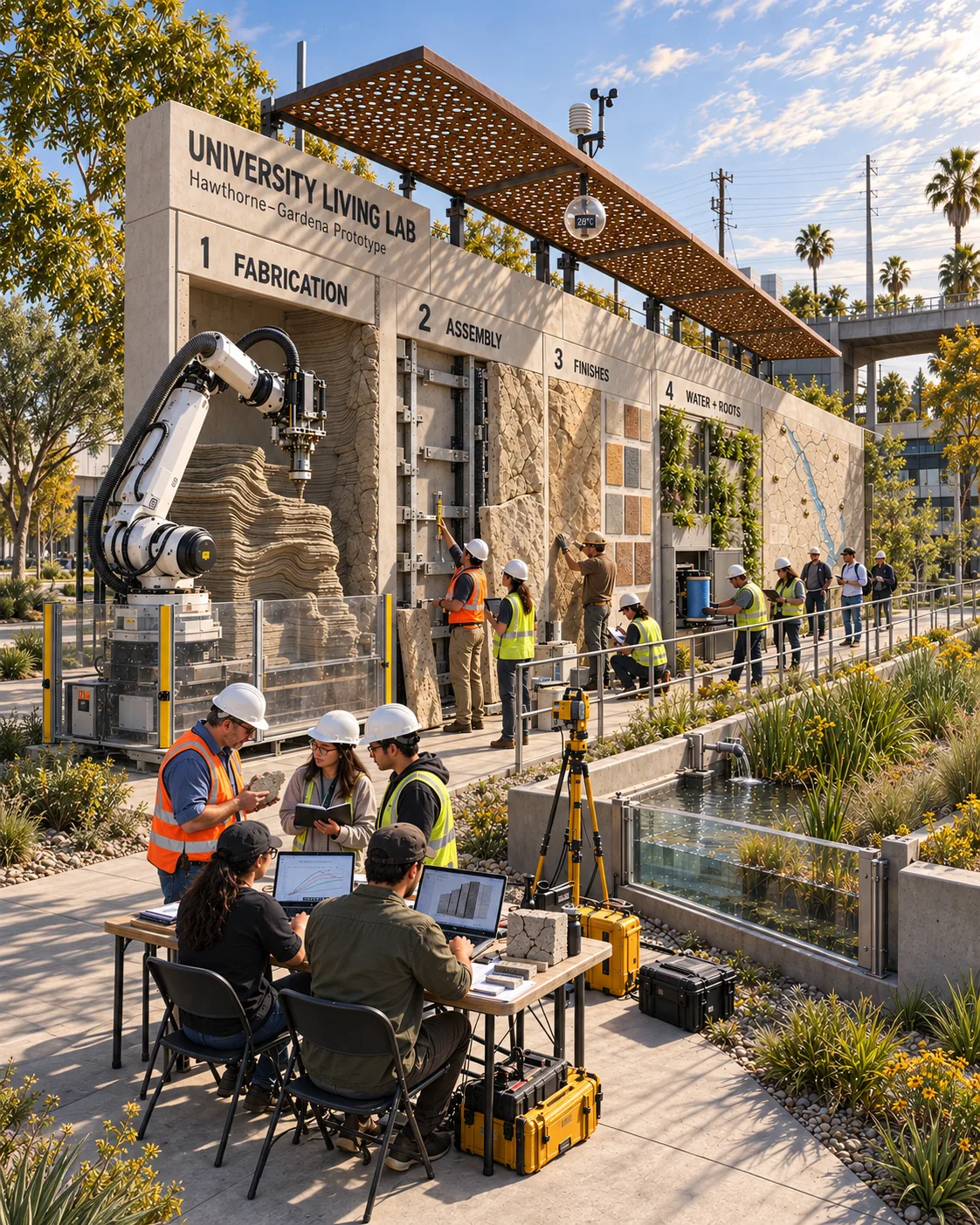
Book references Chapters 27-28: the Vascular LA Studio and university testbeds. Chapter 51: the qualification ladder.
10The next reachable step
Start with a place. Earn the next scale.
The book's near-term proposal is a portfolio of six bounded investigations, not a commitment to rebuild Los Angeles all at once.
Hawthorne-to-Gardena is the most developed demonstration concept. It would pair the existing flood-control channel with a separate, cleanable treatment edge and a shaded public route. Channel function, maintenance access, and emergency requirements remain primary; the treatment cell handles only a defined flow.
A proposed two-year trial would establish a baseline and evaluate water treatment, access, thermal conditions, costs, reporting, and neighborhood effects. Its initial public interface would be non-contact. A candidate corridor near Alondra Park and El Camino College is not a selected or authorized site.
Every pilot needs a named operator, funded care, acceptance criteria, stop rules, and a plan for renewal, removal, or transfer. Two years of operation cannot prove a full service life or performance in a rare event that never occurs during the trial.

Six questions to investigate
01Hawthorne-GardenaA cleanable treatment edge
Can a compact, lined treatment cell remove selected pollutants while crews can safely clear sediment, exchange media, inspect connections, and keep a useful public route open?
02Lower LA River & Gateway CitiesPublic life beside flood infrastructure
Can a landside combination of shade, habitat, access, and bounded runoff treatment improve daily use while protecting flood conveyance, emergency access, and inspection routes?
03BallonaControlled freshwater emergence
Can a permitted, carefully monitored sub-cell clarify the relationship between shallow groundwater, surface water, habitat, and neighboring exposure? Conservation responsibilities and the actual review process would govern any trial.
04Montebello & Rio HondoInland groundwater response
Would an authorized change in recharge timing or volume produce a distinguishable hydraulic-head response? The goal is better evidence for groundwater models, not a presumption that one local result proves basin-wide protection.
05DominguezA kidney corridor
Which treatment, containment, air-monitoring, and response arrangements can address a selected industrial-water reach without exposing neighbors or confusing a cleaner-looking channel with a safe one?
06Hydroseismic demonstration blockA controlled laboratory experiment
How do compartmentalized water, baffles, and a conventional structural frame behave together under defined loading? Comparisons with a dry configuration would test the mechanism; they would not establish district-scale earthquake protection.
A roadmap governed by readiness
The book's planning bands overlap. Dates express an order of investigation, not a construction promise. Expansion depends on evidence, permissions, public commitments, and the ability to operate what has been built.
- 2026-2035Establish the foundations
Agreements, baselines, contamination studies, testbeds, and bounded demonstrations.
- 2035-2050Expand proven corridors
Operating water supply, qualified components, funded care, housing safeguards, and useful transport.
- 2050-2065Integrate at district scale
Connect successful systems after complete operating-and-review cycles justify the next configuration.
- 2065-2076Coordinate and renew
Link successful districts, replace aging assets, reassess coastal strategies, and review the commitments.
Failure is part of the research brief
Contaminant movement, loss of pumping, damaged attachments, inaccessible routes, misleading data, displacement, and unaffordable maintenance must have responses before commissioning. A pilot may be redesigned, remain small, or close. Honest results are more valuable than an expansion the evidence cannot support.
Book references Chapters 50-55: six pilots, qualification, Hawthorne-to-Gardena, failure, Gaia, and the 2026-2076 roadmap.