Skip to Books
Gardens of EarthBooks & audio

The books · Eric Storm

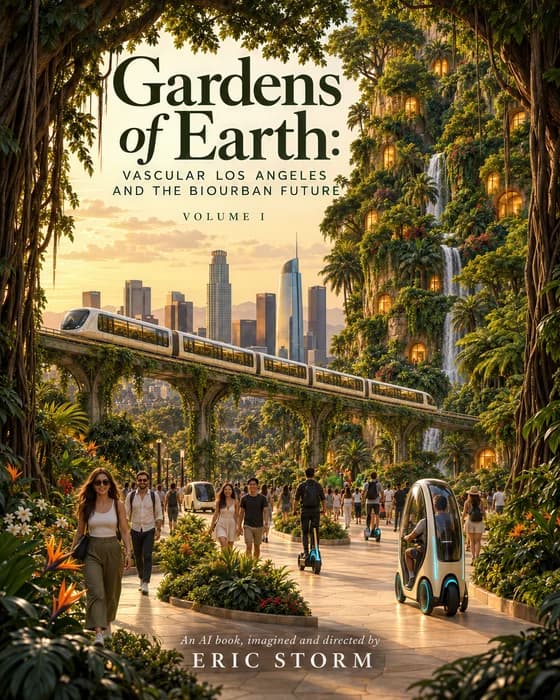
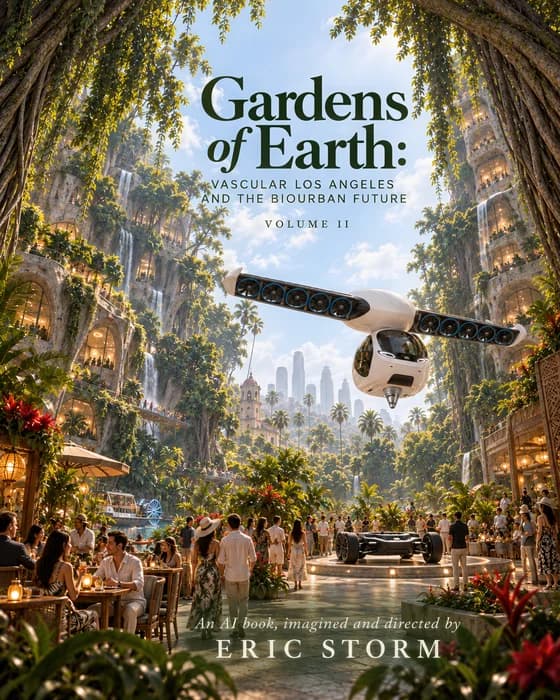
Gardens of Earth

Vascular Los Angeles and the Biourban Future

A two-volume exploration of how a city could become a connected life-support system: shaded, water-literate, human-centered, and cared for over time.

Gardens of Earth, Volume I, by Eric Storm.

Volume I

The ground beneath the vision

Water, infrastructure, contamination, inhabited terrain, and the work of learning to build and care. The first volume develops the physical and technical questions behind Vascular Los Angeles, connecting imagined city life with the systems that would have to support it.

Full M4B audiobook

$7 USD

Works with Apple Books on Mac and VLC on Mac and Windows.

Buy Volume I audiobook

Continue to Payhip to purchase this audiobook.

Kindle ebook

View Kindle edition on Amazon

See Amazon for current availability and delivery.

Paperback

View paperback on Amazon

See Amazon for current availability, pricing and delivery.

Gardens of Earth, Volume II, by Eric Storm.

Volume II

Movement, public life, and the path to proof

Mobility, heat, canopy, culture, financing, public power, and the right to remain. The second volume connects the city’s daily experience with stewardship, proposed pilots, and a gradual roadmap governed by evidence and the ability to maintain what is built.

Full M4B audiobook

$7 USD

Works with Apple Books on Mac and VLC on Mac and Windows.

Buy Volume II audiobook

Continue to Payhip to purchase this audiobook.

Kindle ebook

View Kindle edition on Amazon

See Amazon for current availability and delivery.

Paperback

Available soon

For readers and builders

A vision to explore. A reference to return to.

The books combine imagined experiences of future cities with detailed technical discussions of infrastructure, mobility, water systems, architecture, and simulation. Some sections are more demanding than general-interest nonfiction and may reward slower reading or revisiting alongside the books’ illustrations.

The technical sections can also serve as a conceptual reference for serious builders, designers, and planners developing ideas of their own. The proposals require project-specific engineering and validation.

Eric Storm conceived the framework and directed the manuscript’s research and development. AI assisted with research, drafting, and illustrations. The audiobook uses AI narration. The illustrations are concept studies; they depict proposed environments rather than completed projects.

Hear the ideas

A Boat on the River

Listen to a short excerpt from Volume I, Chapter 9. Load the controls when you are ready; nothing plays automatically.

Audiobook preview · 3:33

A Boat on the River

Volume I · Chapter 9 · Ceded River Lands and Freshwater Moats

An imagined electric-boat journey leads into the water-management and engineering questions behind the landscape.

AI-narrated audio. Playback starts only when you choose Play.

Load the controls when you are ready to listen. Audio is not downloaded on page arrival.

Open the audio preview file
Read the preview transcript

A Boat on the River

The boat is electric, nearly silent beneath its shade canopy. It leaves a civic landing beside an inland neighborhood and moves along a freshwater moat. People walk beneath solar shades on the bank. Beyond the planted edge, the river occupies its own broad flood channel. The two waterways belong to the same landscape, but their water follows different rules.

The passengers are a mix of residents, visitors, and a school group watching the birds. Ahead, a landing opens onto a public square. Farther along, the ground rises toward another neighborhood. The waterway might climb with it through a lock, or end at a landing where passengers continue on foot or by transit. That choice belongs to the places the route can usefully connect.

This is one possible reach of a regional system. Other reaches would carry water through planted basins, support habitat beside the river, or convey clean water past polluted ground. A moat could remain level within a district while a separate pipe carries suitably treated water to wells that inject it deep into an aquifer. The public landscape can extend across Los Angeles without requiring every pool to share one elevation.

Channelization after the catastrophic 1938 flood provided essential protection while constraining the river’s ecological and public life. Recovering some of those functions requires attention to each reach’s ground, flood capacity, water, and neighboring communities.

The ceded river lands program works at that regional scale. Along the Los Angeles River, the San Gabriel and Rio Hondo system, Dominguez Channel, and Ballona Creek, different ground conditions call for different forms. These waterways do not all belong to one drainage system, and the aquifers beneath them follow boundaries of their own. Connections between districts may depend on supply pipes, public paths, and coordinated operation as much as on open water.

At the coast, the landscape changes again. The lowest roughly three miles of the Los Angeles River already have a soft bottom and tidal water. A heron feeding on an exposed mudflat depends on that changing edge. The regional network must leave room for the estuary’s existing life while investigating freshwater landscapes farther inland.

## Engineering the Transformation

The transformation begins with the task assigned to each reach. A basin intended for public life needs a dependable operating level and clean water. A flood channel needs room to carry a storm. A recharge site needs suitable ground and a receiving aquifer. Those functions can support one another, but their requirements must be worked out separately.

One form is a managed reach within the river, held by an adjustable water-level regulator. Another is a freshwater moat beside it, with its own inlet, outlet, circulation, and emergency drawdown. Separate basins deserve close investigation because their everyday water levels can be managed independently of the main flood route. They still require land, supply, and a design that accounts for the flood that reaches their banks.